
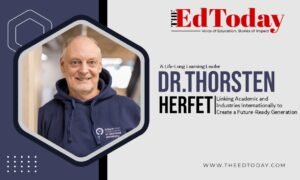
A Life-Long Learning Leader – Dr. Thorsten Herfet: Linking Academic and Industries Internationally to Create a Future-Ready Generation
In modern times, education must encompass everything. It may be related to personal and professional life. It might be about learning particular subjects like science, mathematics, computers, history, geography, chemistry, physics, and all the others. Or it might be about gaining knowledge and wisdom in different fields of our world, our universe in general. For anything and everything, learning via formal education not only influences our present but also transforms our tomorrow. Moreover, this education must be connected with industry so that those emerging from academia can begin their professional careers wherever and whenever they want.
It is where leaders like Dr. Thorsten Herfet are making a crucial difference. As one of the most influential educational leaders, Dr. Herfet’s continuous engagement in both academia and industry is commendable. In his over four decades of experience—20 years as a university professor and 22 years in various industrial positions—Dr. Thorsten Herfet reached the top in both worlds. On the industry side, he has been renowned as a VP of Basic R&D in a company with five thousand plus employees.
On the other hand, as a full-time university professor in one of the top-three computer science departments in Germany, Dr. Thorsten Herfet guided hundreds if not thousands of students to gain their academic excellence.
At the beginning, Dr. Herfet’s journey began long ago. Being an Engineer by profession, he has always been excited about collaborative research: doing something that helps develop the world, together with interdisciplinary teams from academia, institutional, and industrial research. It is within such projects that Dr. Thorsten Herfet says he could keep in contact with young people on a variety of career paths, which inspired him to create a long-term goal of academic research and education. While academic careers due to the rarity of positions and therewith the incredible competition require not only individual career planning but also a lot of chance, he has embarked on industrial research first and, having had the opportunity in 2004, returned to academia.
A Transitional Phase
Dr. Herfet’s post-PhD journey was a transitional phase. Indeed, in his own words, “One of the few points during my personal journey really calling for an either/or decision has been the Postdoc phase. Originally targeted at the Habilitation (and having been able to fulfill all requirements with respect to teaching, research, and publications), my doctoral father gave the advice to not go for the Venia Legendi but rather full-heartedly step into industrial research. In his view, the way back to academia then would open once the time has come. At that point in time, I had to trust, and in the end, he proved to be right.”
After the Postdoc, Dr. Thorsten Herfet says he was lucky to be able to lead very large collaborative research projects (the largest had an overall funding of 33 Mio. € with nineteen fantastic academic, institutional, and industrial partners). “And I could evolve to become a research director in an LSE (Large Scale Enterprise).” With the decay of consumer electronics in many geographies, especially in Europe, Dr. Thorsten Herfet stepped into the world of US-based stock companies and joined Intel. A relationship that lasted for 15 years, even after he was appointed a university professor. “It’s this diversity of cultures and people that keeps fascinating and motivating me, and I’m grateful to everyone along this career path who has been open to letting me participate,” says Dr. Herfet.
An Interesting Shift
Then, coming back to academia has been a shock in the first place, he adds. Stepping out of an extroverted, financially healthy US company into a publicly funded German University, and the introverted overall character of academic research has really been ‘interesting’. A pivotal moment surely has been his appointment as the Dean of the Department of Mathematics and Computer Science in 2006, only 1.5 years after having joined the University. While he didn’t yet have any local reputation, Dr. Herfet’s major task has been to successfully participate in the German Excellence initiative and establish a so-called Excellence Cluster at Saarland University. Being fresh in the department, he obviously didn’t yet have any significant academic standing.
Still, he says, an adorable team of colleagues surrounded him and was able to guide him with the experience of various large projects and the instinctive feeling of what would be required to build a story that convinces all stakeholders. In the end, Saarland has been the only place in Germany where Computer Science alone has been endowed with an excellence cluster as well as a graduate school, more than doubling the size of the department.
While several other engagements followed (Intel financed the so called Intel Visual Computing Institute 2009–2018, and 2014–2017, Dr. Thorsten Herfet had been the University’s Vice President for Research and Technology Transfer), this first success surely has been his step into the great team at Saarland University— “to a certain extent also giving back the trust they put into me when accepting me as a family member.”
A Humble Professor Grounded in Humility
Although he has over 22 years in the industry, holding various roles, one must think that they reached the top, Dr Herfet says he has never had the feeling of being at the top. Chief Engineer at his Alma Mater, Director of Research, Dean but not Speaker of the Excellence Cluster, Co-Director of the Intel Visual Computing Institute, Vice President of the University; there is a pattern showing that he always contributed, supported but have let others enjoy the driving seat (and in each career phase there have been sufficient candidates fighting for this driving seat). This pattern is valid up to today, where, in his most recent engagement in the Scheer School of Digital Sciences at Saarland University, Dr. Thorsten Herfet heads the so-called co-operation platform, the joint undertaking of the University and a non-profit commercial undertaking, the latter being the legal representative of the school to the outside. “While this pattern might not have been planned, it shows where I obviously feel best placed. I think one of the positive sides of this pattern is not to be eaten up with responsibilities but always have a bit of energy left for reflection and the bigger picture.”
Bridging the Theoretical-Practical Divide
Moreover, Dr. Herfet’s continuous engagement in both academia and industry shaped his perspective on bridging theoretical research with real-world applications. In his own words, other than in humanities or natural sciences, research in engineering and computer sciences, while still being fundamental and heading towards optimal solutions, often deals with shorter timescales. This is due to the extremely fast development of these areas, but also related to the expectation of society: While foundations in Mathematics or revelations in deep space are fascinating, engineering and computer science shape the daily life of citizens. Consequently, having the (anticipated) practical relevance on the radar has always been important for Dr. Thorsten Herfet, not at all saying that thinking even more fundamentally and long-term wouldn’t have the same importance. While some academics might feel industrially funded projects are limiting, his personal experience has always been that the practical relevance they bring and the view on far shorter-term, business-relevant visions and decisions are an inspiring facet that he would not like to miss. The Scheer School of Digital Sciences at Saarland University, in this sense, is an ideal playground: Educating with academic excellence while building the curriculum alongside practical questions and problems is the right way to go.
Overcoming Obstacles
As someone who’s reached peak positions in both worlds, Dr. Thorsten Herfet conquered his share of challenges. According to him, the major challenge when bridging worlds is the lack of full acceptance in each of them individually. “Under the assumption that we all do our best and in peak positions all have the same order of engagement, intellect, and skills, it is tautological that one can never be the most respected expert in several domains.” Hence, it is partially a conscious decision not to go for the peak positions but find your own place in each of the families. Personally, he says he is proud of being a valued member of several families, even though—or maybe even because—not being the head of either of those.
A Specialized Academic-Industrial Collaborator
Acquiring and managing international collaborative R&D projects is Dr. Herfet’s specialty. “It is my passion as collaborative research widens the perception.” Whether cultural, educational, or simply from biological age, the mixture of people in collaborative research is fascinating and inspiring. As a side effect, collaborative research projects are typically larger and hence create a larger visibility and impact than individual projects.
“While each and every project has its highlights, two stand out for me personally.” The project EMBASSI, a very large collaborative project funded by the German Federal Ministry of Education and Research (name at that time), brought together academia, institutional research, and partners from the consumer electronics and automotive industries. Dr. Thorsten Herfet adds, “We have first demonstrated multimodal, human-centric assistance systems that we all enjoy today (adaptive cruise control in vehicles, speech recognition in smart homes, all under a common technical architecture and guided by psychologists and UX designers). And I had the pleasure of being the overall project leader.”
Within SAUCE, a project funded by the European Commission under the Horizon 2020 program, they have been the first to build and showcase a portable light field array. Demonstrations and recordings together with the SR (Saarländischer Rundfunk, the public broadcaster in Saarland) created a lot of awareness, “And paved the way into Multiview imaging, which also all of us enjoy in the mobile phones today,” reveals Dr. Thorsten Herfet.
He continues that the major lesson learned from these experiences is to stay open-minded, simply interested in what fellow travelers feel would have the potential to deeply influence, if not change, the world in the foreseeable future.
As a member of the Board of Directors for Industry Consortia and Standardization Bodies, Dr. Thorsten Herfet has developed his approach to create specifications and standards that last. He says that the relevance of standards has somewhat changed over the last few decades. While at the start of his career standards have been the holy grail for manufacturers of mass market products (his PhD thesis developed filters for backwards compatible transmission of 16/9 images in analog TV-systems and has been an essential patent in the so called PALplus standard, and the standards of the Digital Video Broadcasting project up to today specify the way (linear) digital television is broadcast), paradigm shifts like Everything over IP/IP over Everything have led to many standards more being agreements. The way IETF works (in comparison to ITU or ISO/IEC)—despite the fact that both are needed—shows that even those agreements, since adaptable via software updates, in many cases can change much faster than in the past; “Something that contributes to the extremely fast development of the technical means we use in our daily life.”
A Journey of Continuous Transformation
Dr. Herfet’s dual expertise played a crucial role in transforming educational practices to better prepare students for industry needs. He says that this is a very interesting aspect and points to his motivation to become engaged in the Scheer School of Digital Sciences at Saarland University: While still 80+% of all students enter an industrial profession, academic education often targets cutting-edge research. This is important, since teaching significantly deepens the understanding of topics and hence not only educates undergraduate students, but at the same time PhD students, researchers, and professors. Critical Thinking as well as problem-solving are fundamental skills even in the most recent competence frameworks, so this way of academic teaching is still relevant. Still, the Scheer School, as a non-profit but commercial undertaking, offers a way to—outside the legal boundaries of a state-financed public University—build a holistic, didactically well-founded curriculum around those future skills. It’s an inspiring idea to substantially change the way of teaching (and by this of learning) without undermining the academic quality. “I hope my dual expertise in both industry and academia helps the School to find the proper balance between practical relevance on the one hand and fundamental acquisition of competences on the other hand,” believes Dr. Thorsten Herfet.
Shaping a Knowledge-powered Future
Looking ahead, according to Dr. Thorsten Herfet, the speed by which generations are shaped by technology has increased, making this harder and harder for the majority of citizens: GenZ is shaped by LLMs or AI in general, GenY has seen smart phones dramatically change their way of life, GenX has been the first to be globally connected via the Internet and the Boomers—the largest group of citizens today—had to embrace all of this and are the ones able to anticipate what this speed of change implies.
That is why Dr. Thorsten Herfet insists that teaching must change fundamentally to enable students to become an educated part of future societies. “We must make sure that the competences we teach prepare students for the unexpected, since even we as academics can predict less and less the disruptive changes that happen. Keep in mind that LLMs appeared less than five years ago and impact all facets of our lives.”
Advice on Lifelong Learning
When asked to advise aspiring leaders aiming to emulate his path of excellence in both academia and industry, Dr. Thorsten Herfet says instead, “It is very hard to give advice, since I’ve seen many career paths to be successful and to help make the world we live in more fair, more non-discriminatory, more inclusive; simply more worth living in. But on a very general scale, I would say that the permeability between learning, doing, and teaching must be increased. Isn’t the model of “a teacher” anachronistic in itself? Learning something at <30 years and then teaching this for at least another 30 years doesn’t seem appropriate anymore. Life-Long-Learning, Life-Long-Doing, and Life-Long-Teaching, so a far more mutual dispersion of knowledge seems to be far more sustainable. And one cannot do one without the other, so my real advice would be: “Be open and ready to learn, do and teach throughout your life.”
Sketching an Ideal Image of Future Education
Dr. Thorsten Herfet states that the Scheer School of Digital Sciences at Saarland University is yet another collaborative undertaking, this time more focused on education than on research, but along the same lines of collaboration between various disciplines, qualifications, and biological as well as scientific ages. With a very innovative setup, the school can offer academic programs—even under the quality-ensuring system accreditation of Saarland University—beyond what departments can do. Hence, it can implement, test, and document approaches that are very hard, if not impossible, to holistically implement at publicly funded Universities and by this become an inspiration for future education also at universities.
Now, every student might be having the same question: “Why should they—as a student applicant—go for the Scheer School of Digital Sciences at Saarland University?”
Dr. Thorsten Herfet answers that while studying at Saarland University with its international flavor and excellence in many disciplines in any case is the best decision a student could make, especially for those who already have professional experience of at least one year and who are looking for a very attractive package of innovative learning and teaching, industry collaboration from day one and a role-modelling support throughout the learner lifecycle, the Scheer School of Digital Sciences at Saarland University is a unique opportunity they should not miss.